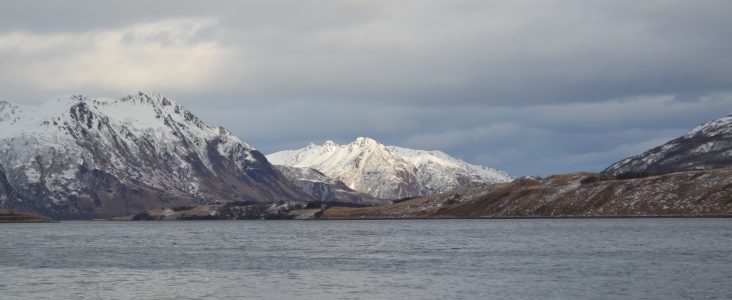
I’ve been living in Alaska for almost two years now. Its beauty did not draw me, but it is keeping me, pulling me in storm by storm, sunrise by sunrise. I spent eight years in Nebraska before I moved here. The beauty of Alaska strikes you immediately and requires little initial interpretation, but Nebraska’s beauty is more nuanced. There are two times a year that I find Nebraska beautiful. In late spring, the deep and seemingly honest green of corn plants, not yet a foot tall, juxtaposed against the still visible black soil is a study in contrasts and makes me thankful that I can see the beauty of blacks and greens. Then there is a time in the fall, after harvest, where the landscape is dominated by several shades of gold – from the bones of cornstalks still remaining in the fields with their splintered skeletons covering the soil to the surrounding grasses and trees whose chlorophyll has conceded to the other pigments. Combine any of these scenes with a Nebraska sunset, uncensored by buildings constructed by man or created by God, and it is enough to inspire and enliven even scabby souls like mine.
This is all well and good, at least as a description of a corn field can be, but I have always found Nebraska wanting – well, not always, but at least since I moved to Alaska. This Nebraska beauty I have described, though it is beautiful is not quite true. It’s like a photograph of a swimsuit model after it has been Photoshopped. When I take in these scenes, the appreciation and inspiration is obscured by a part of me that wonders what it looked like before. Before genetically modified seeds were planted in rows plowed by a GPS controlled tractor whose sticker price would rival any European supercar. Before giant sprinklers sprayed water in precise amounts, with perfectly sized drops engineered in a laboratory, as they claw around in circles like beasts of burden that never have to be led or fed. Before weeds were killed at just the right time by spraying everything with Roundup and then waiting for the harvest. Before crop insurance and subsidies. Before the stretch marks and cellulite were erased and the thigh gap added. Before men tamed God.
The beauty of Alaska is not so. Women and men who make their living on the seas have very little in common with the farmers I know. Their insurance doesn’t protect them from weather or from fish who, for whatever reason, didn’t wander their way this year. Even the best technology cannot create ex nihilo. I can look out the window of a bush plane, my office, my living room, well, really any window anywhere in my village, and I do not have to wonder what it looked like before. The waters have not been restrained and diverted nor are the waves controlled for the convenience of those who work on them. On Kodiak Island, there is no lack of blacks and greens, bordered by clarion blue-gray waters. Mountains teeter on the ocean’s edges. How they remain standing in the storms I do not know. They remain as they always have, on their terms, and we are at their mercy. Beaches come and go with the tides, sometimes like the steady rhythm of a peaceful heart, other times like the heart of an out of shape science teacher running a 5K, where you’re not entirely sure what will happen next – will it pound so hard that it might break through or will it just stop? I have found beauty, and a strange kind of peace, in the uncertain and unpredictable, in living in a land where neither my brain nor my brawn can change things. I once posted a picture of the view from my front porch and wrote something profound about the land in which I have been placed. But I told a friend of mine that living here is really like making out with a bodybuilder. Now, I have no personal experience in making out with a bodybuilder. My wife is a body builder, as evidenced by my three wonderful daughters, but she is not a bodybuilder. But I imagine, when I was 16 I probably imagined things like this frequently, that making out with a bodybuilder could be a lot of fun unless she got angry, or bored, and decided to twist this or break that, flaunting her power over me. And even in the deepest and sweetest embrace, she reminds me that she is in charge. That is Alaska.
For much of my history as a follower of Jesus, life in the Spirit was a lot like the beauty of Nebraska. It had an appeal and a predictability and an appearance of beauty, but much of it was contrived and controlled — controlled by upper middle class white guys who plowed precisely and planted perfectly. Stuff even grew, but God was tamed. What didn’t grow right or look right or sprouted up out of line was simply killed with an indiscriminate application of theological Roundup or a generous dusting of labels like “liberal,” “watered down,” and “heresy.” Yield and uniformity, after all, is what’s important. Acres and bushels turn into attendance and capital campaigns for building programs – buildings that will be perpetually empty except for a couple of hours a couple of times a week. It’s all corn, corn as far as the eye can see. It can be pretty, and can even be pretty useful, but it is not entirely true. Over the last several years, I have found an Alaskan theology exceedingly more beautiful – primarily because I know that I don’t and that I can’t control it. Not only can I not control it, I can’t predict it, manage it, organize it, or alliterate it in a snappy sermon. Even when grace allows me to get my hands on it, to participate in its pleasures, and to experience its benefits, there is never any doubt about who is in control. Well, maybe there is some doubt, but there is no doubt that it is not me. And that is also grace. The God I serve and seek is beautiful and true, but he is not tame.

 Shapes and Stories
Oh my goodness, Curtis, this is gorgeous—and so very true. This is what holds me in Alaska as well—the rawness of creation, that we cannot tame it; that it is we who must conform to it. And this is the most profound truth of human life before God. thanks for these words, which deepen my own understanding of the place I call home.
LikeLike